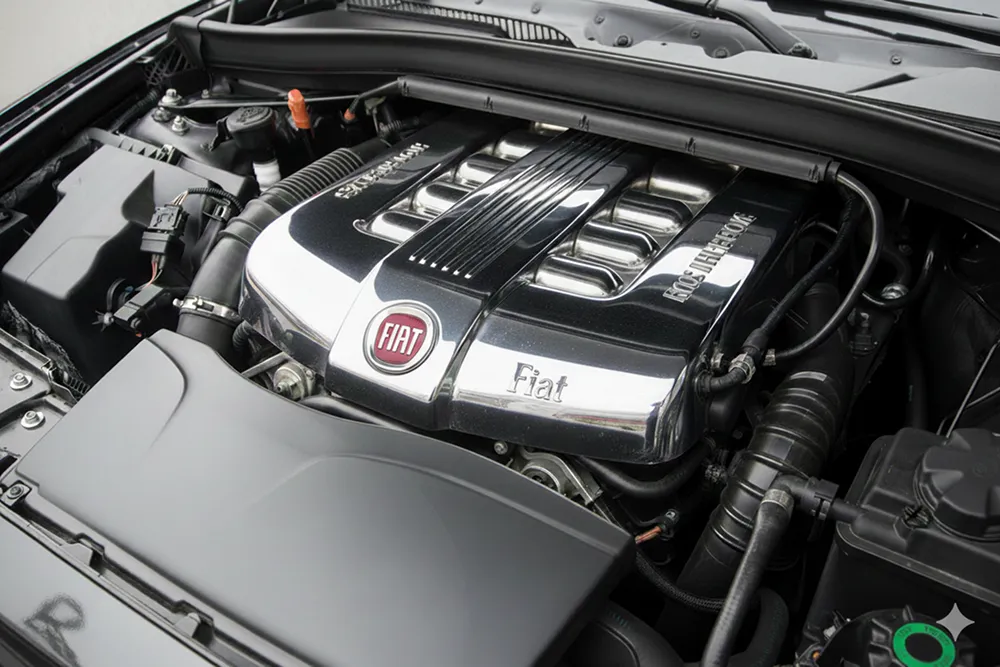
The Fiat 141 C2.000 is a 1,995 cc inline — four petrol engine produced between 1983 and 1987 as part of Fiat's executive sedan lineup. It features a cast — iron block, overhead valve (OHV) configuration, and twin — choke carburettor fuel delivery, delivering smooth mid — range performance suitable for long — distance cruising and fleet applications.
Fitted to the Fiat 132 and later 141 sedans, this engine was engineered for enhanced refinement and drivability over smaller u…
Production years 1983–1984 meet pre-EC Directive 70/220/EEC standards; 1985–1987 models comply with updated national implementations of Euro 1-equivalent limits .
The Fiat 141 C2.000 is a 1,995 cc inline-four OHV petrol engine engineered for executive sedans (1983–1987). It combines a durable cast-iron block with twin-choke carburettor fuel delivery to deliver refined performance. Designed to meet early European emissions norms, it balances mechanical robustness with ease of serviceability.
| Parameter | Value | Source |
|---|---|---|
Displacement | 1,995 cc | |
Fuel type | Petrol | |
Configuration | Inline-4, OHV, 8-valve | |
Aspiration | Naturally aspirated | |
Bore × stroke | 84.0 mm × 90.0 mm | |
Power output | 77 kW (105 PS) @ 5,200 rpm | |
Torque | 155 Nm @ 3,000 rpm | |
Fuel system | Twin-choke carburettor (Weber 36 DCF) | |
Emissions standard | Pre-70/220/EEC; later models meet Euro 1 equivalent | |
Compression ratio | 8.8:1 | |
Cooling system | Water-cooled | |
Turbocharger | Not applicable | |
Timing system | Chain-driven camshaft | |
Oil type | Refer to vehicle handbook / manufacturer specification | |
Dry weight | 142 kg |
The Fiat 141 C2.000 was used across Fiat's 141 platform with longitudinal mounting and no licensed external usage. This engine received platform-specific adaptations-upgraded cooling in the 141 L and emissions-tuned carburettors in UK-market sedans-and from 1985 the facelifted 141 series adopted revised valve train components, creating minor service part distinctions. All adaptations are documented in OEM technical bulletins.
Engine Finders UK Ltd, which operates EngineCode.uk, can pass your enquiry to engine suppliers in the UK. The service is for vehicles in the United Kingdom, with UK delivery or fitting. This is a commercially connected service, and sending an enquiry does not confirm diagnosis or compatibility.
Diagnostic reminder: If a technician has recommended replacing the engine, you can send an enquiry to engine suppliers in the UK. Confirm the diagnosis first: an engine-code record does not diagnose a fault.
Field reports and technical service bulletins highlight component wear patterns under high-load operation. Adherence to manufacturer service intervals and approved fluid specifications is critical for long-term reliability.
Analysis derived from Fiat technical bulletins (1983-1987) and UK DVSA historic failure statistics (1980-1990). Repair procedures should follow manufacturer guidelines.
The most common questions about engine codes, what they mean, how to find them and how this database works
The 141 C2.000 is mechanically robust and capable of long service life when maintained properly. Early models (1983–1984) may exhibit higher oil consumption due to original valve stem seals, but post-1985 revisions improved durability. Regular carburettor servicing, cooling system maintenance, and use of correct SAE 10W-40 oil are essential for longevity. Well-preserved examples remain dependable in classic and collector use.
The most frequent issues include carburettor icing and mixture instability, valve stem seal degradation leading to oil smoke, cooling system failures from aged radiators, and distributor cap carbon tracking. These are documented in Fiat service bulletins and field reports. Ethanol in modern fuel exacerbates carburettor wear, making use of non-ethanol petrol advisable.
This 2.0L petrol engine was used in the Fiat 141 (2.0 S/L), 141 Automatica, and late-model 132 SL from 1983 to 1987. It was standard in European and export markets requiring a larger four-cylinder option. No licensed applications in other brands are documented for this variant.
Yes, within limits. Performance tuning typically includes a high-flow air filter, performance camshaft, and modified exhaust manifold. Some enthusiasts upgrade to dual Weber 40 DCOE carburettors for increased output. However, the OHV design limits high-RPM potential. Modifications should preserve reliability, and ignition timing must be recalibrated after any upgrade.
Factory figures indicate approximately 10.5 L/100km (27 mpg UK) in combined driving. Real-world consumption varies between 9.5–11.5 L/100km (24–30 mpg UK) depending on driving style and condition. The carburetted engine is less efficient than modern fuel-injected units, but regular maintenance helps maintain optimal economy.
No. The Fiat 141 C2.000 uses a non-interference OHV design. If the timing chain fails, the pistons will not contact the valves, preventing catastrophic internal damage. However, replacement of the timing chain and tensioner is still recommended at 120,000 km or as per service schedule to ensure continued reliability.
Fiat specifies SAE 10W-40 mineral oil meeting API SE standards. This viscosity and formulation are critical for proper lubrication of the camshaft, lifters, and valve train. Synthetic oils are not recommended due to potential compatibility issues with older seals. Oil should be changed every 10,000 km or annually to prevent sludge and wear.
Comprehensive technical documentation and regulatory references
EngineCode.uk is operated by Engine Finders UK Ltd. It provides engine-reference information and an optional commercial enquiry service. It is not an official manufacturer website. Check the record's sources and confirm vehicle-specific details before relying on it for parts, repairs or replacement.
Our editorial standard prioritises relevant manufacturer documentation and official regulatory sources. The sources and verification status for a record should be checked alongside the data.
A statement is not verified merely because a source is listed. Where supporting evidence is missing or conflicting, the record should identify that limitation. Please report unsupported or inconsistent information.
Transparency in gaps
A missing or unverified value does not mean the manufacturer has withheld it. We distinguish information not yet verified, information not available to us, and information explicitly not disclosed by the source.
Regulatory Stability
EU regulations are referenced using CELEX identifiers for long-term stability.
EUR-Lex
EU emissions and type-approval regulations (e.g., CELEX:32007R0715, CELEX:32017R1151).
GOV.UK: Vehicle Approval & V5C
UK vehicle approval processes, import rules, and MoT guidance.
DVLA: Engine Changes & MoT
Official guidance on engine swaps and inspection implications.
Vehicle Certification Agency (VCA)
UK type-approval authority for automotive products.
Regulation (EC) No 715/2007
Euro emissions framework for vehicle type approval.
Commission Regulation (EU) 2017/1151
WLTP and RDE testing procedures for emissions certification.
GOV.UK: Vehicle Approval
UK compliance and certification requirements for imported and modified vehicles.
VCA Certification Portal
Type-approval guidance and documentation.
Records are subject to review and correction. Source links, dates and verification notes should be read with the technical information. Our Editorial and Sourcing Policy explains our standards and review process.
Found an error or missing source? Report a problem with this page. Include the field or statement concerned and a supporting source if available. You can also email corrections@enginecode.uk.
Copyright and permissions
Images and other material may be protected by copyright. Attribution does not by itself grant permission to reuse material. If you believe material on this site infringes your rights, contact copyrights@enginecode.uk with the page URL and details of your claim. We will review the material and take appropriate action.
Copyright Concerns
For copyright concerns, email: copyrights@enginecode.uk
Our Privacy Policy explains how Engine Finders UK Ltd uses information from visits, vehicle lookups, enquiries and messages. Our Cookie Policy explains cookies and similar technologies and how to change your choices.
For access, correction, or deletion requests, email: gdpr@enginecode.uk
Trademark Notice
All trademarks, logos, and engine codes are the property of their respective owners. Use on this site is strictly for reference and identification.
Ownership and commercial services
EngineCode.uk is owned and operated by Engine Finders UK Ltd. Alongside our reference content, we offer an optional replacement-engine enquiry service through Engine Finders and may identify relevant services provided by businesses connected with us. These commercial connections are disclosed. Using an enquiry service is not required to read our reference content.
Engine Finders UK Ltd operates this website. Our optional enquiry service has a commercial purpose. Our Ownership and Commercial Disclosure explains the relationship between the reference website and that service. Participating suppliers pay a fee or subscription to participate on the network and receive quote requests.
Use this record as a starting point for identification. Specifications and vehicle applications may contain errors or omissions. Confirm the exact engine variant and compatibility using vehicle-specific documentation and a qualified supplier or technician.
All external links open in new tabs. Please verify current availability of resources.